2 Απρ 2025

How to Maximize Your Efforts with the 80/20 Rule


The Pareto Principle, or the 80/20 Rule, suggests that a small percentage of inputs often leads to the majority of outputs. By identifying and focusing on the vital few factors that drive results, individuals and businesses can optimize their efforts and achieve greater success with less effort.


The Pareto Principle, commonly known as the 80/20 Rule, is a powerful concept that can transform the way we approach work, finances, and even personal life. This principle asserts that a small percentage of causes often leads to a large percentage of effects. In this blog post, we will explore the origins of the Pareto Principle, its applications in various fields, and how you can leverage it to enhance your productivity and success.


The Origins of the Pareto Principle

The Pareto Principle is named after Italian economist Vilfredo Pareto, who discovered this phenomenon in the late 19th century. While studying the economy in Italy, Pareto observed that approximately 20 percent of landowners owned 80 percent of the land. This observation led him to investigate similar patterns in other countries and sectors, revealing that a small number of inputs often accounted for the majority of outputs.


Although Pareto made his discoveries in the 1890s, the principle did not gain widespread recognition until the 1940s when Dr. Joseph Juran popularized it. Juran emphasized the importance of focusing on the few vital factors that yield the most significant results, a concept that has since been applied across various domains.


Real-Life Examples of the Pareto Principle

The 80/20 Rule can be observed in many aspects of daily life:


Workplace Dynamics: In many organizations, a small group of employees tends to handle the majority of critical tasks, while others may contribute less significantly.

Consumer Behavior: In business, it is common for a small percentage of clients to generate a large portion of revenue. For instance, a business might find that 20 percent of its customers account for 80 percent of its sales.

Personal Habits: In our daily routines, we often spend most of our time in a few key areas. For example, in a typical home, individuals may spend the majority of their time in just a few rooms, such as the bedroom, kitchen, and living room.

Applying the Pareto Principle to Your Life

Understanding the Pareto Principle can significantly impact your productivity and effectiveness. Here are some practical ways to apply this principle:


1. Focus on High-Impact Activities

In any role, whether in sales, freelancing, or project management, identify the 20 percent of activities that yield 80 percent of your results. For example, if you are in sales, you might find that networking generates the majority of your sales. By prioritizing networking over less impactful tasks like emails or reports, you can increase your earnings.


2. Delegate or Eliminate Low-Value Tasks

Once you identify the high-impact activities, consider delegating or eliminating tasks that consume time but do not contribute significantly to your success. For instance, if administrative tasks take up a large portion of your day, hiring an assistant to handle these tasks can free up your time for more productive activities.


3. Optimize Client Relationships

For freelancers or business owners, it is crucial to recognize which clients contribute most to your income. Focus on nurturing relationships with these key clients to ensure their satisfaction and loyalty, which can lead to repeat business and referrals.


4. Apply the Principle Across Various Areas

The Pareto Principle is not limited to work or finances. You can apply it to your social life, time management, and even personal development. Identify the few relationships or activities that bring you the most joy and fulfillment, and invest more time in those areas.


Conclusion

The Pareto Principle serves as a reminder that achieving more often requires doing less. By focusing on the vital few factors that drive the majority of your results, you can optimize your efforts and enhance your productivity. Whether in your professional life, finances, or personal relationships, applying the 80/20 Rule can lead to significant improvements and greater satisfaction.


Remember, it is not only possible to accomplish more by doing less; it is essential for success in today's fast-paced world. Embrace the Pareto Principle and start maximizing your efforts today!


Transform Your Financial Life: 6 Lessons from The Richest Man in Babylon


The Richest Man in Babylon offers timeless financial lessons that can transform your wealth mindset. Key principles include paying yourself first, managing expenses, seizing opportunities, investing in passive income, and protecting your assets. By applying these lessons, anyone can achieve financial freedom and a prosperous life.


Did you know that most people in this world live in poverty regardless of how much money they earn? It's hard to believe that money can become a demon that robs us of our freedom and happiness. However, imagine a world where every financial decision you make brings you closer to wealth and financial freedom. This may seem like a distant dream, but the lessons from George Samuel Clason's book, The Richest Man in Babylon, can turn that dream into reality.


The Richest Man in Babylon is a collection of short educational stories about personal financial management, written by George Samuel Clason in the 1920s. The book uses an ancient Babylonian setting to convey fundamental financial principles that remain valuable and applicable today. The lessons in the book are not just theoretical; they are practical, easy to understand, and easy to apply to modern life. This book has inspired millions of people worldwide in building and maintaining wealth.


Lesson 1: Pay Yourself First

One of the most important lessons from the book is the principle of paying yourself first. This means setting aside at least 10% of your income for savings and investments before spending on any other expenses. Look at Warren Buffett, one of the most successful investors in the world; he started saving from a young age and invested wisely. Thanks to this principle, he built a vast financial empire.


I regularly apply this principle by automatically transferring a portion of my salary into a savings account as soon as I receive my paycheck. This helps me maintain financial discipline and ensures that I always set aside a portion for the future instead of wasting money on unnecessary expenses.


Lesson 2: Take Action and Seize Opportunities

We often assume that successful people like Elon Musk or Oprah Winfrey are just lucky. However, the reality is that they do not rely solely on luck; their continuous actions play a crucial role. Elon Musk founded SpaceX and Tesla and relentlessly works to realize his bold ideas. Each failure is merely a stepping stone towards success. Similarly, Oprah Winfrey overcame numerous challenges to become one of the most powerful women in the world.


When faced with opportunities, proactive individuals always take advantage of them more than those who procrastinate. By acting immediately when opportunities arise, you significantly increase your chances of success. This is the difference between successful people and those who just watch from the sidelines. Therefore, men of action are luckier because they continuously create opportunities for themselves.


Lesson 3: Manage Expenses Wisely

Many people think that to become wealthy, they need to earn more money. However, the book points out that true wealth comes from managing expenses and making smart investments. Celebrities like Jeff Bezos and Mark Zuckerberg not only earn a lot of money but also know how to manage and reinvest their earnings. This helps them sustainably grow their assets rather than just relying on their current income.


I regularly review and analyze my expenses. By controlling my spending, I can save more and invest in high-potential areas. This helps me not only increase my income but also grow the value of my assets over time. Thus, wealth is not dependent on income but on how you manage and use that income wisely.


Lesson 4: Timing is Crucial

Timing is a crucial factor in every financial decision. The book encourages us to seize opportunities when they arise, even during difficult times. During the 2008 financial crisis, many smart investors bought stocks when prices plummeted. These individuals later reaped enormous profits when the market recovered.


I have experienced tough financial times, but instead of avoiding them, I used those opportunities to learn and invest. Making the right decisions during difficult times has helped me strengthen my financial situation and achieve sustainable growth. Therefore, acting when the time is right is one of the most important lessons I apply in life.


Lesson 5: The Power of Passive Income

Passive income is one of the keys to achieving sustainable wealth. When you invest your money wisely, it works for you without needing to work hard continuously. Robert Kiyosaki, author of Rich Dad Poor Dad, emphasized the importance of passive income by investing in real estate and stocks, creating stable income streams that do not depend on daily work.


I always seek ways to invest in passive income sources such as real estate, stocks, and investment funds. This not only helps me increase my income but also ensures that I have a stable financial source in the future, even if I face difficulties at work. Hence, the power of passive income is undeniable in building long-term wealth.


Lesson 6: Protect and Grow Your Assets

Accumulating assets is not just about earning more money; it's also about how you manage and protect those assets. The book highlights the importance of smart investing and protecting assets from risks. The success of business moguls like Bill Gates and Steve Jobs didn't just come from creating groundbreaking products but also from effectively managing their personal finances, ensuring that their assets are always protected and growing.


I always set goals not just to accumulate money but also to protect and grow my assets. This includes diversifying my investments and continuously updating my financial knowledge to make informed decisions. Thus, accumulating assets and personal finance is an indispensable part of the journey toward sustainable wealth.


Conclusion

The lessons from The Richest Man in Babylon have opened a new path for me in managing personal finances and building sustainable wealth. Remember, wealth is not the result of a day or a night but the outcome of smart financial decisions and personal discipline. Anyone can change their financial mindset and move towards wealth by applying these lessons. The key is to stay persistent, maintain financial discipline, and always be ready to learn.


Start today. Take the time to plan your finances and continuously strive to achieve your goals. Wealth is not just about money but about the freedom and happiness it brings. Let the lessons from The Richest Man in Babylon guide you on your path to prosperity and success. Start with the smallest steps, persist in your efforts, and keep learning. Wealth is not a destination but a journey. Turn each day into an opportunity to get closer to your financial goals. With discipline, perseverance, and the right lessons, you can completely change your wealth mindset and build a more prosperous life.


ΑΕΚ vs. Ολυμπιακός: Ένας Κρίσιμος Αγώνας (2 Απρ 25)


Η ΑΕΚ ετοιμάζεται να αντιμετωπίσει τον Ολυμπιακό σε έναν κρίσιμο αγώνα που θα καθορίσει την πορεία της ομάδας στο πρωτάθλημα. 

Μετά από μια σειρά απογοητευτικών αποτελεσμάτων, η ΑΕΚ θέλει να αποδείξει ότι είναι ακόμα μια ισχυρή ομάδα και ότι μπορεί να ανταγωνιστεί τους καλύτερους.

Ο αγώνας με τον Ολυμπιακό είναι ιδιαίτερα σημαντικός για την ΑΕΚ, καθώς ακολουθεί το παιχνίδι με τον Παναθηναϊκό. Μια νίκη απέναντι στον Ολυμπιακό θα δώσει στην ΑΕΚ ώθηση και θα αυξήσει τις πιθανότητές της να κερδίσει το πρωτάθλημα.

Οι προπονητές και των δύο ομάδων έχουν τονίσει τη σημασία του αγώνα και έχουν καλέσει τους παίκτες τους να παίξουν με περηφάνια και να δώσουν τον καλύτερό τους εαυτό. 

Η ΑΕΚ αναμένεται να κάνει κάποιες αλλαγές στην ενδεκάδα της, με στόχο να ενισχύσει την άμυνά της και να δημιουργήσει περισσότερες ευκαιρίες στην επίθεση.

Ο αγώνας ΑΕΚ-Ολυμπιακός είναι πάντα ένα μεγάλο παιχνίδι, και οι φίλαθλοι των δύο ομάδων περιμένουν με ανυπομονησία να δουν ποια ομάδα θα επικρατήσει.


Understand Your True Nature Beyond Identity


When reflecting on the question of identity, many people instinctively associate themselves with their name, job, personality, or life experiences. However, what if everything we associate with our identity is merely a mask—a collection of temporary attributes rather than an expression of our true nature? This blog post delves into the profound understanding shared by mystics, philosophers, and spiritual seekers throughout history: you are not your body, your thoughts, or even your mind. You are something far greater—an eternal consciousness that transcends the material world.


The Flawed Belief of Identity

For much of human history, we have been conditioned to believe that our sense of self is tied to our physical body and the cognitive processes of the brain. This belief is fundamentally flawed. The brain serves merely as an instrument of perception, not the source of consciousness. Evidence from near-death experiences, out-of-body experiences, and extensive research into altered states of awareness suggests that consciousness can exist independently of the brain. This aligns with various spiritual traditions that assert the body is merely a vessel—a temporary avatar for something much greater.


The Challenge of Self-Realization

Ralph Waldo Emerson, a transcendentalist thinker, proclaimed that being yourself in a world that constantly tries to make you something else is the greatest accomplishment. This highlights the challenge of uncovering one's true nature amidst external identities imposed by society. Lao Tzu, the ancient Taoist sage, reminds us that knowing others is intelligence, but knowing yourself is true wisdom. Self-realization transcends intellectual understanding and enters the realm of direct experience.


Hafiz, the Sufi poet, beautifully expressed the idea that the truth of the self is already within us, waiting to be uncovered. When we peel away the layers of personality, ego, and conditioning, what remains is a vast, boundless awareness that is always present—not something we have, but something we are.


The Deception of the Ego

The greatest deception we face is identifying with the ego—a construct of thoughts, emotions, and social conditioning that leads us to believe we are what we own, what we do, and what others think of us. This illusion traps us in suffering, as it fosters fear of loss, failure, and change. Shri Ramakrishna, the Indian mystic, offered a deeper perspective: the mind is like a restless monkey, but you are not the monkey; you are the awareness that watches it.


True freedom comes when we stop identifying with the restless mind and recognize the silent witness within. You are not the voice in your head—the inner dialogue filled with worries, judgments, and expectations is not your essence. The moment you become aware of that voice, you step into your real self—the silent observer, the unchanging presence that watches thoughts come and go.


The Power of Inner Exploration

Carl Jung, the renowned psychologist, stated that those who look outside dream, while those who look inside awaken. This insight reflects the transformative power of inner exploration. Swami Vivekananda reinforced this by stating that you are the soul—free and eternal, ever shining and blissful. You are not the body; you are not the mind.


The mind, conditioned by years of societal programming, will resist this truth. It thrives on attachments, constantly reinforcing the illusion that you are a limited being. To move beyond this illusion, you must learn to observe the mind without becoming entangled in its narratives. Thoughts arise and dissolve, yet the awareness that perceives them remains unchanged.


Emotions and Identity

Emotions are often mistaken for identity. We say, "I am sad" or "I am angry," reinforcing the idea that these feelings define us. Instead, shifting to "I am experiencing sadness" creates distance between our essence and these passing states. If we are not the body or mind, what happens when the body ceases to exist? Many spiritual traditions suggest that consciousness is not bound by physical form. Near-death experiences, mystical insights, and quantum theories point toward the idea that consciousness continues beyond physical death.


In Hinduism and Buddhism, this is seen as the cycle of rebirth, where consciousness takes on new forms. In mystical Christianity and Sufi traditions, the soul is believed to return to its divine source. Even modern physics proposes that consciousness may exist as a fundamental property of the universe rather than being a mere byproduct of brain activity.


Embracing the Timeless Nature of Self

If we accept that consciousness is eternal, then death loses its power over us. The fear of dissolution—the greatest fear of the ego—begins to fade. Instead of resisting the impermanence of the physical world, we learn to embrace the timeless, boundless nature of our true self. Alan Watts, a prominent philosopher, compared individual existence to a wave on the surface of the ocean, stating, "You are not a drop in the ocean; you are the entire ocean in a drop."


Modern neuroscience supports this notion. Studies on meditation and mindfulness show that the default mode network of the brain, responsible for self-referential thinking, becomes less active during deep meditation. This suggests that when we silence the mind, we are not merely relaxing but stepping beyond the conditioned sense of self altogether.


Living Beyond Identity

Once we understand our true nature, how should we live? The realization that we are not confined to a single body or identity should not lead to indifference but rather to a deeper engagement with life. Albert Einstein, though a physicist, understood this truth: a human being is a part of the whole called the universe. He experiences himself, his thoughts, and feelings as something separated from the rest—a kind of optical delusion of his consciousness. This delusion leads to selfishness and suffering, but recognizing the unity of all things leads to wisdom and love.


The Illusion of Time

One of the great barriers to self-realization is the illusion of time. We are conditioned to believe that the past defines us and that the future holds our salvation. However, if we are truly beyond the body and mind, we must also be beyond time itself. Jiddu Krishnamurti pointed to this truth when he said, "Time is the psychological enemy of man." The ego thrives on time, keeping us trapped in stories of who we were and who we might become, distracting us from the reality that we are only ever here and now.


Conclusion

The realization of the infinite self is not an external achievement; it is an inner revolution. It is the moment we stop searching and recognize that what we seek has always been here. True awakening is not about adding something new to ourselves; it is about removing the false, the conditioned, the temporary, and seeing with the eyes of eternity.


8 Hidden Signs You Might Be Wasting Your Life


Have you ever noticed how time slips through your fingers without you even realizing it? You tell yourself you have time, that you'll start tomorrow, next week, or next year. But what if I told you that one day never comes? While you wait, life moves forward without waiting for you to catch up. This blog post explores eight signs that you may be secretly wasting your life, drawing on Stoic philosophy to help you recognize these patterns and take action.


1. You Keep Waiting for the Right Time

One of the biggest illusions that keeps people stuck is waiting for the right time. You tell yourself that someday you'll start chasing your goals or change your habits, but that day never comes. The truth is, there is no perfect time. If you're always waiting for ideal conditions, you'll spend your whole life standing still. Successful people start anyway, even when it's uncomfortable or messy.


Action Steps:

Accept that you'll never feel fully ready.

Take the smallest possible step today.

Stop making excuses disguised as preparation.


2. You Prioritize Comfort Over Growth

Choosing comfort over growth is another way people waste their lives. It's easy to stick with what's familiar and avoid challenges, but comfort is a slow killer of potential. Growth only happens outside your comfort zone. Every skill you've learned came from stepping into the unknown.


Action Steps:

Stop fearing discomfort; welcome it.

Set daily challenges for yourself.

Remember that progress comes from struggle.


3. You Let Other People's Opinions Control You

Letting other people's opinions dictate your actions can lead to a life designed for their approval rather than your fulfillment. The fear of judgment keeps you trapped, and you may find yourself living a life that doesn't reflect your true desires.


Action Steps:

Accept that judgment is inevitable.

Practice making decisions without seeking approval.

Remember that only you have to live with your choices.


4. You Fear Failure More Than You Desire Success

The fear of failure can stop you from even trying. You have dreams and ambitions, but doubt creeps in, convincing you that it's safer to do nothing. However, failure isn't the real enemy; inaction is. Every successful person has faced setbacks but used them as stepping stones to improve.


Action Steps:

Accept that failure is part of success.

Take action despite the fear.

Reframe failure as a lesson, not a loss.


5. You Live in the Past or Future but Not in the Present

Living anywhere but the present moment is a subtle yet dangerous way to waste your life. Whether you're stuck in past regrets or lost in future fantasies, you're missing the opportunities available to you right now. The only time that truly exists is the present.


Action Steps:

Catch yourself drifting into the past or future.

Practice gratitude for the present moment.

Take action today that moves you forward.


6. You Surround Yourself with the Wrong People

Keeping the wrong people around can significantly impact your life. If you're surrounded by negativity or small-minded thinking, it can hold you back from achieving your goals. The right people will inspire and challenge you to grow.


Action Steps:

Evaluate your circle; do they challenge you to grow?

Seek out people who inspire you.

Remember that your environment shapes you.


7. You Let Bad Habits Control You

Letting bad habits take over is a common way to waste your life. Distractions can creep in, leading you to procrastinate on important tasks. Your habits shape your destiny, and consistent disciplined action is necessary for success.


Action Steps:

Recognize what's holding you back.

Take back control by setting boundaries.

Remember that every moment wasted is a moment you'll never get back.


8. You Ignore the Power of Small Daily Actions

Underestimating the power of small daily actions can lead to wasted potential. Real change comes from consistent, small efforts rather than dramatic leaps. Small actions compound over time and can lead to significant results.


Action Steps:

Shift your mindset to trust the process.

Commit to consistency in your daily actions.

Understand that big successes are built from small efforts.


Conclusion

Recognizing these signs is the first step toward reclaiming your life. By taking action, embracing discomfort, and living in the present, you can break free from the habits that hold you back. Remember, the only right time to start living is now. Don't waste another moment; take the first step today.


1 Απρ 2025

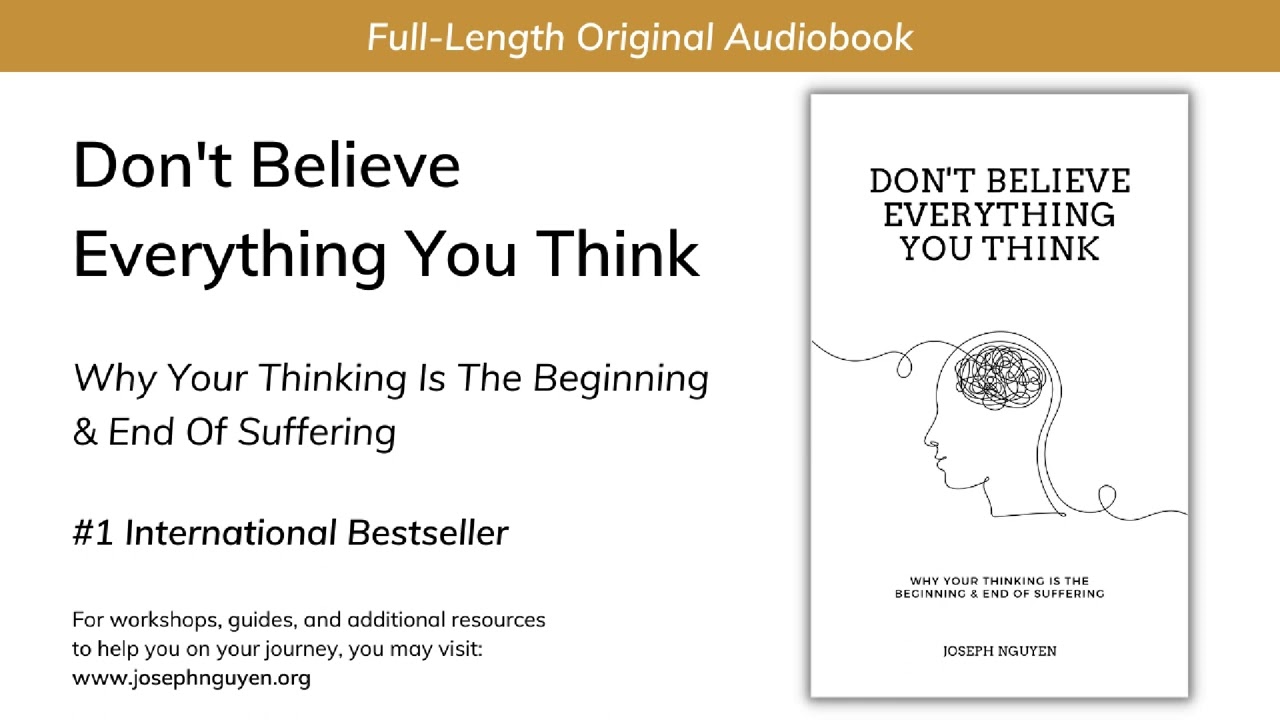
Key Takeaways from Joseph Nguyen's 'Don't Believe Everything You Think'


Joseph Nguyen's audiobook, 'Don't Believe Everything You Think', explores the nature of suffering, emphasizing that our thoughts shape our reality. By understanding the difference between thoughts and thinking, we can alleviate psychological suffering and access a state of peace and joy. The book outlines practical steps to cultivate non-thinking, embrace unconditional love, and create space for inspiration and miracles in our lives.


In his audiobook, "Don't Believe Everything You Think", Joseph Nguyen delves into the profound connection between our thoughts and our experiences of suffering. He asserts that our thinking is often the root cause of our emotional pain, and by changing our relationship with our thoughts, we can transform our lives. This article summarizes the key insights from the audiobook, providing a comprehensive guide to understanding and overcoming psychological suffering.


Acknowledgments

Nguyen expresses gratitude to several mentors and loved ones who have influenced his journey, particularly Sydney Banks, whose principles have shaped his understanding of the human experience. He emphasizes the importance of unconditional love, which he learned from his partner, Kenna, and how it can change the world.


The Purpose of the Book

Nguyen boldly claims that this book aims to help readers find everything they have been searching for in life. He believes that after engaging with the material, readers will undergo significant personal transformation. The book encourages an open mind and a willingness to explore the depths of one's own consciousness.


The Nature of Suffering

Psychological vs. Emotional Suffering

Nguyen distinguishes between unavoidable pain and optional suffering. He explains that while we cannot control the painful events in our lives, we can control our reactions to them. Drawing from Buddhist teachings, he illustrates that suffering often arises from our emotional responses to pain, likening it to being struck by two arrows: the first representing physical pain and the second representing our emotional reaction.


The Journey to Understanding Suffering

Nguyen recounts his personal journey through various self-help methods, therapies, and teachings, ultimately leading him to the realization that suffering stems from our own thinking. He emphasizes that understanding how our minds work is crucial to alleviating suffering.


The Root Cause of Suffering

Thought vs. Reality

Nguyen introduces the concept that we live in a world of thought rather than reality. Our perceptions shape our experiences, and different individuals can have vastly different interpretations of the same event. He uses examples to illustrate how our thoughts about money or political figures can vary widely, highlighting that our feelings are derived from our thinking, not from external events.


The Power of Thoughts

Thoughts are described as energetic raw materials that shape our experiences. Nguyen emphasizes that while we cannot control the thoughts that arise, we can choose how we engage with them. He encourages readers to recognize that their feelings are a direct result of their thinking and that by changing their thoughts, they can change their emotional experiences.


The Importance of Non-Thinking

Embracing Non-Thinking

Nguyen advocates for a state of non-thinking as a means to access peace, joy, and fulfillment. He explains that when we stop overthinking, we create space for positive emotions to surface. This state of flow allows us to connect with our inner wisdom and the universe, leading to miraculous experiences.


Practical Steps to Cultivate Non-Thinking

Awareness: Recognize when you are caught up in thinking and understand that it is the root cause of your suffering.

Create Space: Allow your thoughts to settle without engaging with them. This can be achieved through practices like meditation or mindfulness.

Trust Your Intuition: Follow your gut feelings and inner wisdom, which often guide you toward the right path without the need for over-analysis.

Unconditional Love and Creation

Nguyen discusses the transformative power of unconditional love, which he learned from his partner. He emphasizes that true love does not depend on conditions or reasons, and this realization can lead to profound personal growth and creativity.


The Role of Goals and Dreams

Inspiration vs. Desperation

Nguyen differentiates between goals created from inspiration and those born from desperation. Goals driven by desperation often lead to feelings of scarcity and anxiety, while those inspired by genuine passion lead to fulfillment and joy. He encourages readers to pursue their dreams from a place of abundance rather than lack.


Conclusion

In "Don't Believe Everything You Think", Joseph Nguyen provides a roadmap for understanding and overcoming suffering through the power of thought. By embracing non-thinking, cultivating unconditional love, and pursuing inspired goals, individuals can transform their lives and experience profound joy and fulfillment. The insights shared in this audiobook serve as a guide for anyone seeking to navigate the complexities of their thoughts and emotions, ultimately leading to a more peaceful existence.